
Many Muslims have come to the USA because they enjoy the freedom guaranteed by our Constitution which could not be enjoyed by them in their countries of origin. If indeed they are here for that reason then they ought to be required to publically renounce Sharia Law. How can we non-islamic citizens be required to trust or respect them othewise? Imagine Sharia Law excusing a parent or relative for physically injuring or killing a daughter or sister for refusing to marry a man or leaving an abusive husband chosen by the relative. Imagine justifying killing a former Muslim who chooses to convert from Islam to another religion. If Muslims want ordinary non-muslim citizens to trust and respect their right of religious freedom then let them publically renounce Sharia Law. Let them accept publically the right of personal choice in religious matters. Let that begin with the leaders of the proposed Mosques in Manhattan and Murfreesboro, TN. How can we trust them otherwise? Let Mr Obama be the first to ratify this idea or quit supporting Islam publically.
Let them also renounce the absolutely offensive doctrine that men will enjoy endless physical sex with unlimited virgins for eternity. What an evil doctrine! How does that sound in light of Islamic claims of equality of the sexes? I can not think that any non-muslim woman could see equality in eternity in that perverted doctrine. At present Muslim women dare not, without fear, renounce that ugly doctrine which means enslavement in eternity and thus here too.
Thursday, November 18, 2010
Islam and Sharia Law in the USA
Monday, November 8, 2010
The Song of Solomon: A Drama
SONG OF SONGS
Rather than seeing this poem as a declaration of Jesus' love for the church, as some do; it is much better to see it as a play extolling the power and dignity and beauty of true devotion and physical sensual love between young lovers; in spite of the interferance of Solomon, who is trying to win the affection of a strikingly beautiful young maiden whom he has seen at work in a field. He has transported her to his harem in hopes of wooing and winning her to his harem. In spite of many gifts and tender wooing by Solomon, her devotion and love remain true to her young shepherd. After many failed attempts, Soloman accepts defeat (in Song 8:7) and restores her to her young shepherd.
The style of the poem is in the form of a play although the speakers are not named before their parts as they would be in a play. I have added the names of the speakers where I think they ought to be. The cast consists of: Soloman; The Shulamite maiden; members of Solomon's harem called Daughters of Jerusalem; Solomon's personal guards; city watchman; the young shepherd.
1The Song of Songs, which is Solomon's
2Shulamite: Let him kiss me with the kisses of his mouth: for your love is better than wine. 3Because of the savor of your good ointments your name is as ointment poured out,therefore the virgins love you. 4Draw me, we will run after you: the king has brought me into his chambers: we will be glad and rejoice in you, we will remember your love more than wine: the upright love you. 5O you daughters of Jerusalem, I am black, but comely, as the tents of Kedar, as the curtains of Solomon. 6Do not look on me, because I am black, because the sun has looked on me: my mother's children were angry with me; they made me the keeper of the vineyards; but I have not kept my own vineyard.
7Solomon: Tell me, O you whom my soul loves, where you feed, where you make your flock to rest at noon: for why should I be as one who turns aside by the flocks of your companions? 8If you do not know, O you fairest among women, go your way out by the footsteps of the flock and feed your kids beside the shepherds' tents. 9I have compared you, O my love, to a company of horses in Pharaoh's chariots. 10Your cheeks are comely with rows of jewels, your neck with chains of gold. 11We will make you borders of gold with studs of silver.
12Shulamite: While the king sits at his table, my spikenard sends forth its smell. 13A bundle of myrrh is my wellbeloved to me; he shall lie all night between my breasts. 14My beloved is to me as a cluster of camphire in the vineyards of Engedi.
Solomon: 15Behold, you are fair, my love; behold, you are
fair; you have doves' eyes. 16Behold, you are fair, my beloved, yes, pleasant: our bed also is green. 17The beams of our house are cedar, and our rafters of fir.
Chapter 2
The Shulamite dreams: 1I am the rose of Sharon, and the lily of the valleys. 2As the lily among thorns, so is my love among the daughters. 3As the apple tree among the trees of the wood, so is my beloved among the sons. I sat down under his shadow with great delight and his fruit was sweet to my taste. 4He brought me to the banqueting house and his banner over me was love. 5Stay me with flagons, comfort me with apples: for I am sick of love. 6His left hand is under my head and his right hand embraces me. 7I charge you, O you daughters of Jerusalem, by the roes and by the hinds of the field, that you do not stir up, nor awake my love, till he pleases. 8The voice of my beloved! behold, he comes leaping on the mountains, skipping on the hills. 9My beloved is like a roe or a young hart: behold, he stands behind our wall, he looks out at the windows, showing himself through the lattice. 10My beloved spoke and said to me,
Shepherd: Rise up, my love, my fair one and come away. 11For, lo, the winter is past, the rain is over and gone; 12The flowers appear on the earth; the time of the singing of birds is come and the voice of the dove is heard in our land; 13The fig tree puts forth her green figs and the vines with the tender grape give a good smell. Arise, my love, my fair one and come away.
14Solomon: O my dove, which is in the clefts of the rock, in the secret places of the stairs, let me see your countenance, let me hear your voice; for your voice is sweet and your countenance is
comely. 15Take the foxes for us , the little foxes, that spoil the vines: for our vines have tender grapes.
16Shulamite: My beloved is mine and I am his: he feeds among the lilies. 17Until the day breaks, and the shadows flee away, turn, my beloved and be like a roe or a young hart on the mountains of Bether.
Chapter 3
1The Shulamite dreams: I sought him whom my soul loves by night on my bed: I sought him, but I did not find him. 2I will rise now and go about the city in the streets and in the broad ways I will seek him whom my soul loves: I sought him, but I did not find him. 3The watchmen who go about the city found me: to whom I said, Did you see him whom my soul loves? 4It was but a little that I passed from them and I found him whom my soul loves: I held him and would not let him go, until I had brought him into my mother's house and into the chamber of her who conceived me. 5I charge you, O you daughters of Jerusalem, by the roes and by the hinds of the field, that you do not stir up, nor awake my love, till he pleases.
6Solomon: Who is this who comes out of the wilderness like pillars of smoke, perfumed with myrrh and frankincense, with all powders of the merchant?
7Solomon's guards: Behold his bed, which is Solomon's; sixty valiant men are about it, of the valiant of Israel. 8They all hold swords, being expert in war: every man has his sword on his thigh because of fear in the night. 9King Solomon made himself a chariot of the wood of Lebanon. 10He made its pillars of silver, the bottom of it of gold, the covering of it of purple, the midst of it being paved with love, for the daughters of Jerusalem. 11Go forth, O you daughters of Zion and behold king Solomon with the crown with which his mother crowned him in the day of his espousals and in the day of the gladness of his heart.
Chapter 4
1Soloman: Behold, you are fair, my love; behold, you are fair; you have doves' eyes within your locks: your hair is as a flock of goats, that appear from Mount Gilead. 2Your teeth are like a flock of sheep that are shorn, which came up from the washing; of which every one bore twins, and none is barren among them. 3Your lips are like a thread of scarlet and your speech is comely: your temples are like a piece of a pomegranate within your locks. 4Your neck is like the tower of David built for an armory, on which there hangs a thousand bucklers, all shields of mighty men. 5Your two breasts are like two young roes that are twins, which feed among the lilies. 6Until the day break and the shadows flee away, I will get me to the mountain of myrrh, and to the hill of frankincense. 7You are all fair, my love; there is no spot in you.
8Shepherd: Come with me from Lebanon, my spouse, with me from Lebanon: look from the top of Amana, from the top of Shenir and Hermon, from the lions' dens, from the mountains of the leopards. 9You have ravished my heart, my sister, my spouse; you have ravished my heart with one of your eyes, with one chain of your neck. 10How fair is your love, my sister, my spouse! how much better is your love than wine! and the smell of your ointments than all spices! 11Your lips, O my spouse, drop as the honeycomb: honey and milk are under your tongue; and the smell of your garments is like the smell of Lebanon. 12My sister is an inclosed garden; my spouse a spring shut up, a fountain sealed. 13Your plants are an orchard of pomegranates, with
pleasant fruits; camphire, with spikenard, 14Spikenard and saffron; calamus and cinnamon, with all trees of frankincense; myrrh and aloes, with all the chief spices:
15Shulamite: A fountain of gardens, a well of living waters and streams from Lebanon. 16Awake, O north wind; and come, you south; blow on my garden, so that its spices may flow out. Let my beloved come into his garden and eat his pleasant fruits.
Chapter 5
1Solomon: I have come into my garden, my sister, my spouse: I have gathered my myrrh with my spice; I have eaten my honeycomb with my honey; I have drunk my wine with my milk: eat, O friends; drink, yes, drink abundantly, O beloved.
2The Shulamite dreams: I sleep, but my heart wakes: it is the voice of my beloved who knocks, saying, Open to me, my sister, my love, my dove, my undefiled: for my head is filled with dew, and my locks with the drops of the night. 3I have put off my coat; how shall I put it on? I have washed my feet; how shall I defile them? 4My beloved put in his hand by the hole of the door and my inward parts were moved for him. 5I rose up to open to my beloved; and my hands dropped with myrrh, and my fingers with sweet smelling myrrh, on the handles of the lock. 6I opened to my beloved; but my beloved had withdrawn himself, and was gone: my soul failed when he spoke: I sought him, but I could not find him; I called him, but he gave me no answer. 7The watchmen who went about the city found me, they struck me, they wounded me; the keepers of the walls took my veil away from me. 8I charge you, O daughters of Jerusalem, if you find my beloved, that you tell him, that I am sick of love.
9Harem daughters: What is your beloved more than another beloved, O you fairest among women? what is your beloved more than another beloved, that you charge us so?
10Shulamite: My beloved is white and ruddy, the chiefest among ten thousand. 11His head is as the most fine gold, his locks are bushy, and black as a raven. 12His eyes are as the eyes of doves by the rivers of waters, washed with milk, and fitly set. 13His cheeks are as a bed of spices, as sweet flowers: his lips like lilies, dropping sweet smelling myrrh. 14His hands are as gold rings set with the beryl: his belly is as bright ivory overlaid with sapphires. 15His legs are like pillars of marble, set on sockets of fine gold: his countenance is as Lebanon, excellent as the cedars. 16His mouth is most sweet: yes, he is altogether lovely. This is my beloved and this is my friend, O daughters of Jerusalem.
Chapter 6
1Harem Daughters: Where is your beloved gone, O you fairest among women? where is your beloved turned aside? that we may seek him with you.
2Shulamite: My beloved is gone down to his garden, to the beds of spices, to feed in the gardens and to gather lilies. 3I am my beloved's and my beloved is mine: he feeds among the lilies.
4Solomon: You are beautiful, O my love, as Tirzah, comely as Jerusalem, terrible as an army with banners. 5Turn away your eyes from me, for they have overcome me: your hair is as a flock of
goats that appear from Gilead. 6Your teeth are as a flock of sheep which go up from the washing, of which every one bears twins and there is not one barren among them. 7As a piece of a pomegranate are your temples within your locks. 8There are sixty queens and eighty concubines and virgins without number. 9My dove, my undefiled is but one; she is the only one of her mother, she is the choice one of her who bore her. The daughters saw her and blessed her; yes, the queens and the concubines and they praised her. 10Who is she who looks out as the morning, fair as the moon, clear as the sun, and terrible as an army with banners?
11I went down into the garden of nuts to see the fruits of the valley, and to see whether the vine flourished, and the pomegranates budded. 12When I was aware, my soul made me like the
chariots of Amminadib. 13Return, return, O Shulamite; return, return, that we may look on you. What will you see in the Shulamite? As the company of two armies.
Chapter 7
1Shepherd: How beautiful are your feet with shoes, O prince's daughter! the joints of your thighs are like jewels, the work of the hands of a cunning workman. 2Your navel is like a round goblet,
which does not lack liquor: your belly is like a heap of wheat set about with lilies. 3Your two breasts are like two young roes that are twins. 4Your neck is as a tower of ivory; your eyes like the fishpools in Heshbon, by the gate of Bathrabbim: your nose is as the tower of Lebanon which looks toward Damascus. 5Your head on you is like Carmel and the hair of your head like purple; the king is held in the galleries. 6How fair and how pleasant are you, O love, for delights! 7This your stature is like a palm tree and your breasts to clusters of grapes. 8I said, I will go up to the palm tree, I will take hold of its boughs: now also your breasts shall be as clusters of the vine and the smell of your nose like apples; 9And the roof of your mouth like the best wine for my beloved, that goes down sweetly, causing the lips of those that are asleep to speak.
10Shulamite: I am my beloved's and his desire is toward me. 11Come, my beloved, let us go out into the field; let us lodge in the villages. 12Let us get up early to the vineyards; let us see if the vine flourishs, whether the tender grapes appear, and the pomegranates bud forth: there will I give you my loves. 13The mandrakes give a smell and at our gates are all manner of pleasant fruits, new and old, which I have laid up for you, O my beloved.
Chapter 8
1Shulamite continues to dream: O that you were as my brother, who sucked the breasts of my mother! when I should find you without, I would kiss you; yes, I should not be despised. 2I would lead you, and bring you into my mother's house, who would instruct me: I would cause you to drink of spiced wine of the juice of my pomegranate. 3His left hand should be under my head and his right hand should
embrace me. 4I charge you, O daughters of Jerusalem, that you stir not up, nor awake my love, until he pleases.
Solomon admits defeat:
5 Who is this who comes up from the wilderness, leaning on her beloved? I raised you up under the apple tree: there your mother brought you forth: there she brought you forth who bore you.
Solomon's disappointment and admission of the power of love that he never found for himself:
6Solomon: Set me as a seal on your heart, as a seal on your arm: for love is as strong as death; (My) jealousy is cruel as the grave: the coals of it are coals of fire, which has a most vehement flame.
Solomon's insight and final concluion.
7Solomon: Many waters cannot quench love, neither can the floods drown it: if a man would give all the substance of his house for love, it would be utterly insufficient.
8The Shumamite is released: We have a little sister and she has no breasts: what shall we do for our sister in the day when she shall be spoken for? 9If she is a wall, we will build on her a palace of silver: and if she is a door, we will inclose her with boards of cedar. 10I am a wall and my breasts like towers. Then I was as one who found favor in his eyes.
11Shepherd: Solomon has a vineyard at Baalhamon, He let out the vineyard to keepers. Every one from the fruit of it was to bring a thousand pieces of silver. 12You, O Solomon, have a thousand and those who keep the fruit of it two hundred. But my vineyard is mine, and is before me.
13The Shumamite calls her Shepherd home: You who dwell in the gardens, the companions listen to your voice, Cause me to hear it. 14Make haste, my beloved and be like a roe or a young hart on the mountains of spices.
Wednesday, September 15, 2010
Dead Sea Scrolls hoax
Today an article on Yahoo.com reads:
"The scrolls include the earliest known version of portions of the Hebrew Bible and have shed important light on Judaism and the beginnings of Christianity." (Full text of the article here)
Except for Isaiah and Habakkuk there is very little of Hebrew Bible in the scrolls. Most items are fragments many hardly bigger than a postage stamp.
John the Baptist and Jesus of Nazareth were unique teachers and there is nothing in the scrolls relating to them. Some "scholars" have made money making allegations, but they are far fetched and have been disproved.
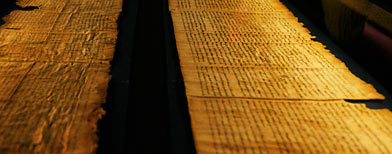
The origin of the scrolls is suspect. There are too many medieval markings in the scrolls to discount. I have some of them cataloged under "Controversial Marks." If interested you can see some of them here.
Also, check here and scroll to the end of the page.
Tuesday, April 20, 2010
Pediphile Priests not limited to 2010
The following was written in Feb. 26 2007
except for Peter who was a bishop in Babylon but no doubt died in Rome, the rest of the first six men listed as Popes in your list may have been bishops of Rome but they made no claim to being the head of all the churches. Historical facts seem clear that there was no fusion of the authority of Spiritual and the temporal or what is known as the Temporality until Justinian in the 6th century. While Constantinople remained in the Catholic community and were participants in the first seven councils they did not a ccept the superiority of the Bishop of Rome over "all the churches."
However in some things I accept the moral superiority of Roman Catholic influence over the secular demon that now holds sway over western civilization. The Roman church held the line on abortion and properly taught that human life begins at the moment of conception. This too while evangelical protestants thought it was a political issue rather than a moral issue and had to be taught by their Roman Catholic friends and who eventually (most of them) adopted the thinking of the Roman church on this issue.
The principles confronting the Roman church on homosexuality are under assault. I hope they can not only hold the moral ground on the issue but get their priesthood cleansed from the sexual sins plaguing the system world wide.
Friday, April 16, 2010
Albert Barnes on Rev 19 written before 1850
And out of the mouth of the false prophet. The word rendered false prophet--qeudoprofhtou--does not before occur in the book of Revelation, though the use of the article would seem to imply that some well-known power or influence was referred to by this. Compare Barnes on "Re 10:3". The word occurs in other places in the New Testament, Mt 7:15; 24:11,24; Mr 13:22; Lu 6:26; Ac 13:6; 2Pe 2:1; 1Jo 4:1; and twice elsewhere in the book of Revelation, with the same reference as here, Re 19:20; 20:10. In both these latter places it is connected with the "beast." "And the beast was taken, and with him the false prophet." "And the devil that deceived them was cast into the lake of fire and brimstone, where the beast and the false prophet are." It would seem then to refer to some power that was similar to that of the beast, and that was to share the same fate in the overthrow of the enemies of the gospel. As to the application of this, there is no opinion so probable as that it alludes to the Mohammedan power--not strictly the Turkish power, for that was to be "dried up" or to diminish; but to the Mohammedan power as such, that was still to continue for awhile in its rigour, and that was yet to exert a formidable influence against the gospel, and probably in some combination, in fact, if not in form, with Paganism and the Papacy. The reasons for this opinion are,
(a) that this was referred to in the former part of the book is one of the formidable powers that would arise, and that would materially affect the destiny of the world--and it may be presumed that it would be again referred to in the account of the final consummation- see Re 9:1-11;
(b) the name "false prophet" would better than any other describe has that power, and would naturally suggest it in future times--for to no one that ever appeared in our world could the name be so properly applied as to Mohammed;
Thursday, April 15, 2010
Ordinary Islam Fosters Terrorism
Islam fosters terrorism. The religion itself is of human origin and archaic. Medieval violence and ugly hatred is imbedded in the religion. It is oppressive to women and any free thought.
The youth in Iran want to over throw the oppression and seek secular freedom. Islam in general itself is in the way of that proper attitude. The God of creation has allowed freedom to choose good or evil for your self in this life until the day of the Great Divide. Then the "blessed and only Potentate" will make the final decisions. At this point you can love him or hate him without impunity. Islam has no such doctrine of freedom of speech or thought for the enemy.
I have been writing and speaking for more than 20 years that Islamic nations will open to religious and political freedom in the season we are living in. The Wahabi militants will not let that happen without murder and mayhem and worse of all is that a majority of so called moderate Islamists condone and intellectually justify the method of murdering working class bus riders and countless children to make their religious-political point.
Just now in the USA our media is beginning to insist on describing the hate filled muslims as "Fundamental Islamist terrorists" instead of the generic term "terrorist" as though terrorist acts are not 99% the product of muslims in Algeria, Somolia, Sudan, Iran, Iraq, Egypt, Indonesia, Saudi, Russia, Palestine, etc. etc. And several now see the terrorist war as an ideological struggle of resurgent Islam with the goal to spread its ugly sharia to every "infidel" nation in the world. The Mosque is the center for hate and destruction, it is inherent in the religion. It will not go away until the religion changes.
This struggle will get worse before it gets better and in all likelihood some one involved in the "Holy Jihad" will detonate an atomic device in a Western city and murder millions to make a point for their false, ungodly, and unholy religion. OK , not every doctrine or cultural expression is bad. So down with the worse! i.e. the Koran, and Mohammed. I am not naive.
Tuesday, April 13, 2010
King Arthur Tour: Joseph of Armethea
About Me
- Fred Miller
- Carrollton, Georgia, United States
- Evangelist and professor of Bible, History, Greek, and Hebrew. Currently living with wife, Charlotte, in Carrollton, Georgia, just outside Atlanta. Please visit my bio at moellerhaus.com for more information.