
Dear Daniel
As far as the outcome or the truth of Daniel chapter 2 is concerned it does not matter whether King Neb. remembered the dream or not, does it?
However" Also my understanding of the stone that grows is the stone represents the Kingdom of God which will destroy all of other earthly kingdoms. "
This sentence should be examined. Does the dream say that the stone would bring down "all the kingdoms of the world?" Or does it say it will bring down four kingdoms and their structure represented by the statue?
That does not mean that there are not other places in the Bible that teach that Jesus will overcome all his enemies in historical time. But that Neb.'s dream is limited to these four empires and their destruction in the fourth and the system associated with it which was started by and passed on by the Babylonians.
The statue represents not only the four kingdoms but also the ethos strenghtened by Nebuchadnezzar that was passed on to the three succeeding kingdoms making it world wide, and would be brought down with the demise of the fourth . The Paganism of the Babylonians was passed on to all those symbolized and come to its end with the struggle with the ethic of Jesus at the time of Constantine when after 300 years of persecution the moral ethic of Jesus overcame was accepted as the truth in the Western World until 1963. Thus chapter 2 in Daniel reached to the end of the Roman Empire and not to the end of the world.
That means that the little stone's appearance and continuation in History is in the past and not to be expected to show up for the first time in the future.
Most of the orthodox denominations accept that the little stone is the church of Christ established some time in the summer of 30 AD and came into conflict with the Roman Empire which ultimately expired and with it the predominance of paganism in the civilized world which condition existed until about 1963 when Satan was loosed from his chains to deceive the nations again, but not the church nor the Christians.
Other fringe groups like the JW's Mormons, Seventh Day folk and many evangelicals of the "Left Behind" persuasion do not see the church of Christ as the Kngdom of God, which it is.
The same four empires are pictured as animals (beasts) in Daniel 7 and the predictions there extend the the parcelling of the Roman Empire into ten kingdoms and the rise of an antichrist kingdom. (If the Ten horns are kingdoms as almost all seem to agree then the little horn is a kingdom as well and not a person.) He has a period of time given to his tenure. In Daniel it is "time, times and half a time" The same figure is given in Revelation as well as 1260 days and fourty two months and three and a half years.. They all represent the same 1260. The year in which the symbol was first given was 360 days, 3 1/2 X 360 = 1260; 42 x 30 = 1260.
The restoration of the pagan ethic (1963 to the present) and the rejection of the ethics of Jesus that held sway in the Western World for about 1600 years marks us as being close to but not at the end. There is more... "Then shall the saints take the kingdom." and "The kingdoms of this world have become the kingdom of our LORD and of His Christ. That will ne history some day.
Many historical interpreters believe the reign of the temporal Papal State combining the authority of Earthly political power with assumed heavenly power began in 533 and the first blow (of seven) to limit that power came in 1793, which end the 1260 day-years of prophecy. The first vial of the last seven was poured out at that time and the demise of the Vatican State lost power by degrees until the present weakened unrepentent condition of their spurious false claim to Statehood. One blow left and the Vatican State, not to say the Roman church, will join other states in the dust bin of history.
If you are interested in a more in-depth study of these same thigs covering Dan 2, abd 7 and Revelation 13 which is built on the seventh chapter of Daniel you can find it here: http://www.moellerhaus.com/rev666.htm
all the best
Create in me a clean heart, O God; and renew a right spirit within me.
Do not cast me away from your presence; and do not take your
Holy Spirit from me. Restore to me the joy of your salvation;
and uphold me with your free spirit.
Fred P Miller
10 Valley Drive
Carrollton, GA 30117
770 214 0627
Cell 770 880 8089
www.moellerhaus.com
Blog: http://moellerhaus.blogspot.com
Please visit Charlotte's paintings and art
http://www.ao.net/~fmoeller/charlt.htm
Hello Mr. Miller,
I thank you for you insight comments about the Euphrates River and the beginning of the divided kingdom between the northern and southern tribes. I hope you did have a nice Christmas, I do have to admit it is really hard for me to focus at times on the true "reason for the season," but at least I have noticed that people tend to be more giving and selfless, some of them anyways. But I wish I would get less caught up in who I need to buy gifts for and more in the fact that I'm supposed to be celebrating a really special event. I have been reading in the book of Daniel about the dream of Nebuchadnezzar and the "great image," that he saw in Daniel chapter 2. I have a couple of questions. I was under the impression that Nebuchadnezzar was troubled by a dream that he had forgotten and for that reason he called his magicians, astrologers, etc. to tell him the dream and then interpret his dream for him. But now that I am reading it again, a footnote attached to the King James version that I have (actually I saw it first in one of my Spanish versions and then I looked it up also in my English King James version) for verse 5. "The king answered and said to the Chaldeans, the thing is gone from me: if you will not make known unto me the dream, with the interpretation.... A footnote referencing the phrase "gone from me," in verse 5 says, Persian: sure with me, then whoever added the footnotes then explains a little, "i.e. he knew his dream and desired to test them." So now that I am reading this chapter again and thinking somewhat in the matter, that does make some sense to me, as the king complains in verse 7 about the Chaldeans, "would gain the time," which seems to me that the Chaldeans are trying to stall to gain time, and in verse 9 the king says; "for ye have prepared lying and corrupt words to speak before me." So I can believe that Nebuchadnezzar wanted to have his dream interpreted, but wasn't totally convinced that his Magicians & Astrologers, etc. would be able to give him the correct interpretation and for that reason he wanted them to tell him his dream first so that way he could feel sure that he would be getting the correct interpretation of his dream instead of being told, "lies and corrupt words." I've read other translations that use the verb to forget in verse 5. Do you feel that to forget or what I quoted before; "the thing is gone from me," is a bad translation or a confusing translation in that verse? Knowing that Nebuchadnezzar remembered his dream fairly well makes a difference as opposed to, I dreamed something, now I feel bothered, and now I want to know what I dreamed about. I easily believe that the king of Babylon didn't really believe in or trust his court magicians, chaldeans, astrologers, and wise men, that they really truly had those special powers that they claimed to have or if they weren't just going to tell him something he wanted to hear. Another thing, I have a question about the dream itself. He saw an image that makes me think of a humanoid, with a head, chest, legs, etc. As a side note, I will have to say that I am favorably impressed with the humility of Daniel in verse 30. Back to the dream, so a humanoid figure made of gold, silver, bronze, iron, and clay destroyed or perhaps crushed into dust by a stone cut out of a mountain without hands that then grows into a mountain. The image of a person apparently represents worldly kingdoms, the Babylonians is one of them for sure, along with perhaps the Persians, Greeks, Romans. Also my understanding of the stone that grows is the stone represents the Kingdom of God which will destroy all of other earthly kingdoms. Okay, but what I really don't understand is the part of the image with feet of clay and iron. I don't understand that, really. The fact that the feet are made out of clay and iron, some kind of divided kingdom that is partially strong due to the iron and partially fragile due to the clay. So feet and toes made out of clay and iron, maybe I just don't understand, but what kind of divided kingdom is strong and fragile (Daniel 2: 41 -43)? Human alliances, but they don't mix together. Well, definitely an interesting chapter, so did Nebuchadnezzar remember his dream or not, and I'm confused about the feet and toes made out of clay and iron. I will have to say that I do find the Old Testament more interesting now that I understand it better. I feel that a lot of that has to do with my studies of your book of Isaiah. I wish you a prosper 2011.
Respectfully Yours,
Daniel
Friday, December 31, 2010
The Little Stone of Daniel 2 * Temperal Vatican Papal State to End Soon
Saturday, December 18, 2010
Hebrew Pronunciation of Jesus' Name
Tim
Your question about the right Hebrew spelling of the name of Jesus or Yeshua.
I am not convinced that getting the "correct" pronunciation of a Hebrew name is all that important nor does the correct pronumciation carry any revelation with it.
And - Also -Importantly - Biblical Hebrew was (is not now) a tonal language. If you look at a Hebrew Masoretic text of the Scriptures you will find 10 or so added markings for vowels added by the masoretes. Masorah means traditional. Different vowel sounds change the meaning of a word. Thus, just in case the proper vowel pronunciation might be lost the masoretic scholars added vowels for what they believed was the traditional and correct reading. For vowels they were probably right most of the time but they were human so their choices are subject to discussion in some cases. However We are dependent on fifth and sixth century Jews (who rejected Jesus as the Messiah) for being able to read the Hebrew text. The unpointed text would be indecipherable to most scholars including Modern-Hebrew speaking scholars. There are just too many possibilities to get it right if those who memorized and, from generation to generation, orally transmitted the masorah, had not developed marks to indicate proper vowel, accent and tone. Modern-Hebrew is a close relative to Biblical Hebrew but it has a much different grammar.
In the masoretic text, beside vowel points, there are about 35 other marks added to indicate kind of accent and probably tones.
There are no forms for tense-time in Biblical Hebrew. There are no forms for subjunctive mode in Biblical Hebrew. At this time these grammatical concepts must be determined by the context. Thus there is disagreement in rendering the tense time of a verb depending on the translaters doctrinal position.
One good example of this among many, many, is Zechariah 8:3 "Thus says the LORD; I am returned to Zion" If you believe as I do that the passage is announcing the return of the Shekina to the Second Temple then the KJV is correct. However if you are a "Futurist" you will follow the NIV and translate "I will (or shall) return to Zion."
Is one of them wrong? No! the tense time depends on the context and therefore the translation is subject to interpretation because there is no tense-time forms in Biblical Hebrew. But, since the concepts of time and subjunctive are a part of any language, they had to be a part of Biblical Hebrew, that is now lost. I believe the tones that are understood only partially by only a few of the current Hebrew scholars would have indicated these concepts.
Like saying the English slang word "yeah." Depending on the tone of voice in English, you might be agreeing with something, or you might be (depending on the tone), expressing extreme doubt.
Thus getting the pronunciation of a name right is an exercise in furility. Getting the pronunciation of a verb correct however will determine whether your doctrinal position is right or wrong.
There are other reasons,in changing spelling, and not being right or wrong, in the pronunciation or vowel pointing of a Hebrew name in the masoretic text. The place of the name in the sentence, whether it is subject or object, and what sounds go before and after, whether it has sufformatives or preformatives added to the word are a few of the reasons the same Hebrew word or name will have a different vowel spelling.
Also; Tim - the question that you asked indicates that you know only a little of the Holy language. I recommend that you take some college level courses in this language. It is a very simple language. But it takes about four years to see the simplicity.
All the best en el nombre de Jesu Christo
o en ho onoma Iasou Christou
Thursday, November 18, 2010
Islam and Sharia Law in the USA
Many Muslims have come to the USA because they enjoy the freedom guaranteed by our Constitution which could not be enjoyed by them in their countries of origin. If indeed they are here for that reason then they ought to be required to publically renounce Sharia Law. How can we non-islamic citizens be required to trust or respect them othewise? Imagine Sharia Law excusing a parent or relative for physically injuring or killing a daughter or sister for refusing to marry a man or leaving an abusive husband chosen by the relative. Imagine justifying killing a former Muslim who chooses to convert from Islam to another religion. If Muslims want ordinary non-muslim citizens to trust and respect their right of religious freedom then let them publically renounce Sharia Law. Let them accept publically the right of personal choice in religious matters. Let that begin with the leaders of the proposed Mosques in Manhattan and Murfreesboro, TN. How can we trust them otherwise? Let Mr Obama be the first to ratify this idea or quit supporting Islam publically.
Let them also renounce the absolutely offensive doctrine that men will enjoy endless physical sex with unlimited virgins for eternity. What an evil doctrine! How does that sound in light of Islamic claims of equality of the sexes? I can not think that any non-muslim woman could see equality in eternity in that perverted doctrine. At present Muslim women dare not, without fear, renounce that ugly doctrine which means enslavement in eternity and thus here too.
Monday, November 8, 2010
The Song of Solomon: A Drama
SONG OF SONGS
Rather than seeing this poem as a declaration of Jesus' love for the church, as some do; it is much better to see it as a play extolling the power and dignity and beauty of true devotion and physical sensual love between young lovers; in spite of the interferance of Solomon, who is trying to win the affection of a strikingly beautiful young maiden whom he has seen at work in a field. He has transported her to his harem in hopes of wooing and winning her to his harem. In spite of many gifts and tender wooing by Solomon, her devotion and love remain true to her young shepherd. After many failed attempts, Soloman accepts defeat (in Song 8:7) and restores her to her young shepherd.
The style of the poem is in the form of a play although the speakers are not named before their parts as they would be in a play. I have added the names of the speakers where I think they ought to be. The cast consists of: Soloman; The Shulamite maiden; members of Solomon's harem called Daughters of Jerusalem; Solomon's personal guards; city watchman; the young shepherd.
1The Song of Songs, which is Solomon's
2Shulamite: Let him kiss me with the kisses of his mouth: for your love is better than wine. 3Because of the savor of your good ointments your name is as ointment poured out,therefore the virgins love you. 4Draw me, we will run after you: the king has brought me into his chambers: we will be glad and rejoice in you, we will remember your love more than wine: the upright love you. 5O you daughters of Jerusalem, I am black, but comely, as the tents of Kedar, as the curtains of Solomon. 6Do not look on me, because I am black, because the sun has looked on me: my mother's children were angry with me; they made me the keeper of the vineyards; but I have not kept my own vineyard.
7Solomon: Tell me, O you whom my soul loves, where you feed, where you make your flock to rest at noon: for why should I be as one who turns aside by the flocks of your companions? 8If you do not know, O you fairest among women, go your way out by the footsteps of the flock and feed your kids beside the shepherds' tents. 9I have compared you, O my love, to a company of horses in Pharaoh's chariots. 10Your cheeks are comely with rows of jewels, your neck with chains of gold. 11We will make you borders of gold with studs of silver.
12Shulamite: While the king sits at his table, my spikenard sends forth its smell. 13A bundle of myrrh is my wellbeloved to me; he shall lie all night between my breasts. 14My beloved is to me as a cluster of camphire in the vineyards of Engedi.
Solomon: 15Behold, you are fair, my love; behold, you are
fair; you have doves' eyes. 16Behold, you are fair, my beloved, yes, pleasant: our bed also is green. 17The beams of our house are cedar, and our rafters of fir.
Chapter 2
The Shulamite dreams: 1I am the rose of Sharon, and the lily of the valleys. 2As the lily among thorns, so is my love among the daughters. 3As the apple tree among the trees of the wood, so is my beloved among the sons. I sat down under his shadow with great delight and his fruit was sweet to my taste. 4He brought me to the banqueting house and his banner over me was love. 5Stay me with flagons, comfort me with apples: for I am sick of love. 6His left hand is under my head and his right hand embraces me. 7I charge you, O you daughters of Jerusalem, by the roes and by the hinds of the field, that you do not stir up, nor awake my love, till he pleases. 8The voice of my beloved! behold, he comes leaping on the mountains, skipping on the hills. 9My beloved is like a roe or a young hart: behold, he stands behind our wall, he looks out at the windows, showing himself through the lattice. 10My beloved spoke and said to me,
Shepherd: Rise up, my love, my fair one and come away. 11For, lo, the winter is past, the rain is over and gone; 12The flowers appear on the earth; the time of the singing of birds is come and the voice of the dove is heard in our land; 13The fig tree puts forth her green figs and the vines with the tender grape give a good smell. Arise, my love, my fair one and come away.
14Solomon: O my dove, which is in the clefts of the rock, in the secret places of the stairs, let me see your countenance, let me hear your voice; for your voice is sweet and your countenance is
comely. 15Take the foxes for us , the little foxes, that spoil the vines: for our vines have tender grapes.
16Shulamite: My beloved is mine and I am his: he feeds among the lilies. 17Until the day breaks, and the shadows flee away, turn, my beloved and be like a roe or a young hart on the mountains of Bether.
Chapter 3
1The Shulamite dreams: I sought him whom my soul loves by night on my bed: I sought him, but I did not find him. 2I will rise now and go about the city in the streets and in the broad ways I will seek him whom my soul loves: I sought him, but I did not find him. 3The watchmen who go about the city found me: to whom I said, Did you see him whom my soul loves? 4It was but a little that I passed from them and I found him whom my soul loves: I held him and would not let him go, until I had brought him into my mother's house and into the chamber of her who conceived me. 5I charge you, O you daughters of Jerusalem, by the roes and by the hinds of the field, that you do not stir up, nor awake my love, till he pleases.
6Solomon: Who is this who comes out of the wilderness like pillars of smoke, perfumed with myrrh and frankincense, with all powders of the merchant?
7Solomon's guards: Behold his bed, which is Solomon's; sixty valiant men are about it, of the valiant of Israel. 8They all hold swords, being expert in war: every man has his sword on his thigh because of fear in the night. 9King Solomon made himself a chariot of the wood of Lebanon. 10He made its pillars of silver, the bottom of it of gold, the covering of it of purple, the midst of it being paved with love, for the daughters of Jerusalem. 11Go forth, O you daughters of Zion and behold king Solomon with the crown with which his mother crowned him in the day of his espousals and in the day of the gladness of his heart.
Chapter 4
1Soloman: Behold, you are fair, my love; behold, you are fair; you have doves' eyes within your locks: your hair is as a flock of goats, that appear from Mount Gilead. 2Your teeth are like a flock of sheep that are shorn, which came up from the washing; of which every one bore twins, and none is barren among them. 3Your lips are like a thread of scarlet and your speech is comely: your temples are like a piece of a pomegranate within your locks. 4Your neck is like the tower of David built for an armory, on which there hangs a thousand bucklers, all shields of mighty men. 5Your two breasts are like two young roes that are twins, which feed among the lilies. 6Until the day break and the shadows flee away, I will get me to the mountain of myrrh, and to the hill of frankincense. 7You are all fair, my love; there is no spot in you.
8Shepherd: Come with me from Lebanon, my spouse, with me from Lebanon: look from the top of Amana, from the top of Shenir and Hermon, from the lions' dens, from the mountains of the leopards. 9You have ravished my heart, my sister, my spouse; you have ravished my heart with one of your eyes, with one chain of your neck. 10How fair is your love, my sister, my spouse! how much better is your love than wine! and the smell of your ointments than all spices! 11Your lips, O my spouse, drop as the honeycomb: honey and milk are under your tongue; and the smell of your garments is like the smell of Lebanon. 12My sister is an inclosed garden; my spouse a spring shut up, a fountain sealed. 13Your plants are an orchard of pomegranates, with
pleasant fruits; camphire, with spikenard, 14Spikenard and saffron; calamus and cinnamon, with all trees of frankincense; myrrh and aloes, with all the chief spices:
15Shulamite: A fountain of gardens, a well of living waters and streams from Lebanon. 16Awake, O north wind; and come, you south; blow on my garden, so that its spices may flow out. Let my beloved come into his garden and eat his pleasant fruits.
Chapter 5
1Solomon: I have come into my garden, my sister, my spouse: I have gathered my myrrh with my spice; I have eaten my honeycomb with my honey; I have drunk my wine with my milk: eat, O friends; drink, yes, drink abundantly, O beloved.
2The Shulamite dreams: I sleep, but my heart wakes: it is the voice of my beloved who knocks, saying, Open to me, my sister, my love, my dove, my undefiled: for my head is filled with dew, and my locks with the drops of the night. 3I have put off my coat; how shall I put it on? I have washed my feet; how shall I defile them? 4My beloved put in his hand by the hole of the door and my inward parts were moved for him. 5I rose up to open to my beloved; and my hands dropped with myrrh, and my fingers with sweet smelling myrrh, on the handles of the lock. 6I opened to my beloved; but my beloved had withdrawn himself, and was gone: my soul failed when he spoke: I sought him, but I could not find him; I called him, but he gave me no answer. 7The watchmen who went about the city found me, they struck me, they wounded me; the keepers of the walls took my veil away from me. 8I charge you, O daughters of Jerusalem, if you find my beloved, that you tell him, that I am sick of love.
9Harem daughters: What is your beloved more than another beloved, O you fairest among women? what is your beloved more than another beloved, that you charge us so?
10Shulamite: My beloved is white and ruddy, the chiefest among ten thousand. 11His head is as the most fine gold, his locks are bushy, and black as a raven. 12His eyes are as the eyes of doves by the rivers of waters, washed with milk, and fitly set. 13His cheeks are as a bed of spices, as sweet flowers: his lips like lilies, dropping sweet smelling myrrh. 14His hands are as gold rings set with the beryl: his belly is as bright ivory overlaid with sapphires. 15His legs are like pillars of marble, set on sockets of fine gold: his countenance is as Lebanon, excellent as the cedars. 16His mouth is most sweet: yes, he is altogether lovely. This is my beloved and this is my friend, O daughters of Jerusalem.
Chapter 6
1Harem Daughters: Where is your beloved gone, O you fairest among women? where is your beloved turned aside? that we may seek him with you.
2Shulamite: My beloved is gone down to his garden, to the beds of spices, to feed in the gardens and to gather lilies. 3I am my beloved's and my beloved is mine: he feeds among the lilies.
4Solomon: You are beautiful, O my love, as Tirzah, comely as Jerusalem, terrible as an army with banners. 5Turn away your eyes from me, for they have overcome me: your hair is as a flock of
goats that appear from Gilead. 6Your teeth are as a flock of sheep which go up from the washing, of which every one bears twins and there is not one barren among them. 7As a piece of a pomegranate are your temples within your locks. 8There are sixty queens and eighty concubines and virgins without number. 9My dove, my undefiled is but one; she is the only one of her mother, she is the choice one of her who bore her. The daughters saw her and blessed her; yes, the queens and the concubines and they praised her. 10Who is she who looks out as the morning, fair as the moon, clear as the sun, and terrible as an army with banners?
11I went down into the garden of nuts to see the fruits of the valley, and to see whether the vine flourished, and the pomegranates budded. 12When I was aware, my soul made me like the
chariots of Amminadib. 13Return, return, O Shulamite; return, return, that we may look on you. What will you see in the Shulamite? As the company of two armies.
Chapter 7
1Shepherd: How beautiful are your feet with shoes, O prince's daughter! the joints of your thighs are like jewels, the work of the hands of a cunning workman. 2Your navel is like a round goblet,
which does not lack liquor: your belly is like a heap of wheat set about with lilies. 3Your two breasts are like two young roes that are twins. 4Your neck is as a tower of ivory; your eyes like the fishpools in Heshbon, by the gate of Bathrabbim: your nose is as the tower of Lebanon which looks toward Damascus. 5Your head on you is like Carmel and the hair of your head like purple; the king is held in the galleries. 6How fair and how pleasant are you, O love, for delights! 7This your stature is like a palm tree and your breasts to clusters of grapes. 8I said, I will go up to the palm tree, I will take hold of its boughs: now also your breasts shall be as clusters of the vine and the smell of your nose like apples; 9And the roof of your mouth like the best wine for my beloved, that goes down sweetly, causing the lips of those that are asleep to speak.
10Shulamite: I am my beloved's and his desire is toward me. 11Come, my beloved, let us go out into the field; let us lodge in the villages. 12Let us get up early to the vineyards; let us see if the vine flourishs, whether the tender grapes appear, and the pomegranates bud forth: there will I give you my loves. 13The mandrakes give a smell and at our gates are all manner of pleasant fruits, new and old, which I have laid up for you, O my beloved.
Chapter 8
1Shulamite continues to dream: O that you were as my brother, who sucked the breasts of my mother! when I should find you without, I would kiss you; yes, I should not be despised. 2I would lead you, and bring you into my mother's house, who would instruct me: I would cause you to drink of spiced wine of the juice of my pomegranate. 3His left hand should be under my head and his right hand should
embrace me. 4I charge you, O daughters of Jerusalem, that you stir not up, nor awake my love, until he pleases.
Solomon admits defeat:
5 Who is this who comes up from the wilderness, leaning on her beloved? I raised you up under the apple tree: there your mother brought you forth: there she brought you forth who bore you.
Solomon's disappointment and admission of the power of love that he never found for himself:
6Solomon: Set me as a seal on your heart, as a seal on your arm: for love is as strong as death; (My) jealousy is cruel as the grave: the coals of it are coals of fire, which has a most vehement flame.
Solomon's insight and final concluion.
7Solomon: Many waters cannot quench love, neither can the floods drown it: if a man would give all the substance of his house for love, it would be utterly insufficient.
8The Shumamite is released: We have a little sister and she has no breasts: what shall we do for our sister in the day when she shall be spoken for? 9If she is a wall, we will build on her a palace of silver: and if she is a door, we will inclose her with boards of cedar. 10I am a wall and my breasts like towers. Then I was as one who found favor in his eyes.
11Shepherd: Solomon has a vineyard at Baalhamon, He let out the vineyard to keepers. Every one from the fruit of it was to bring a thousand pieces of silver. 12You, O Solomon, have a thousand and those who keep the fruit of it two hundred. But my vineyard is mine, and is before me.
13The Shumamite calls her Shepherd home: You who dwell in the gardens, the companions listen to your voice, Cause me to hear it. 14Make haste, my beloved and be like a roe or a young hart on the mountains of spices.
Wednesday, September 15, 2010
Dead Sea Scrolls hoax
Today an article on Yahoo.com reads:
"The scrolls include the earliest known version of portions of the Hebrew Bible and have shed important light on Judaism and the beginnings of Christianity." (Full text of the article here)
Except for Isaiah and Habakkuk there is very little of Hebrew Bible in the scrolls. Most items are fragments many hardly bigger than a postage stamp.
John the Baptist and Jesus of Nazareth were unique teachers and there is nothing in the scrolls relating to them. Some "scholars" have made money making allegations, but they are far fetched and have been disproved.
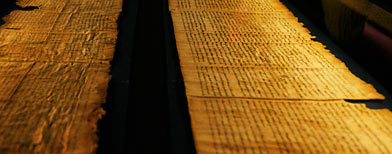
The origin of the scrolls is suspect. There are too many medieval markings in the scrolls to discount. I have some of them cataloged under "Controversial Marks." If interested you can see some of them here.
Also, check here and scroll to the end of the page.
Tuesday, April 20, 2010
Pediphile Priests not limited to 2010
The following was written in Feb. 26 2007
except for Peter who was a bishop in Babylon but no doubt died in Rome, the rest of the first six men listed as Popes in your list may have been bishops of Rome but they made no claim to being the head of all the churches. Historical facts seem clear that there was no fusion of the authority of Spiritual and the temporal or what is known as the Temporality until Justinian in the 6th century. While Constantinople remained in the Catholic community and were participants in the first seven councils they did not a ccept the superiority of the Bishop of Rome over "all the churches."
However in some things I accept the moral superiority of Roman Catholic influence over the secular demon that now holds sway over western civilization. The Roman church held the line on abortion and properly taught that human life begins at the moment of conception. This too while evangelical protestants thought it was a political issue rather than a moral issue and had to be taught by their Roman Catholic friends and who eventually (most of them) adopted the thinking of the Roman church on this issue.
The principles confronting the Roman church on homosexuality are under assault. I hope they can not only hold the moral ground on the issue but get their priesthood cleansed from the sexual sins plaguing the system world wide.
Friday, April 16, 2010
Albert Barnes on Rev 19 written before 1850
And out of the mouth of the false prophet. The word rendered false prophet--qeudoprofhtou--does not before occur in the book of Revelation, though the use of the article would seem to imply that some well-known power or influence was referred to by this. Compare Barnes on "Re 10:3". The word occurs in other places in the New Testament, Mt 7:15; 24:11,24; Mr 13:22; Lu 6:26; Ac 13:6; 2Pe 2:1; 1Jo 4:1; and twice elsewhere in the book of Revelation, with the same reference as here, Re 19:20; 20:10. In both these latter places it is connected with the "beast." "And the beast was taken, and with him the false prophet." "And the devil that deceived them was cast into the lake of fire and brimstone, where the beast and the false prophet are." It would seem then to refer to some power that was similar to that of the beast, and that was to share the same fate in the overthrow of the enemies of the gospel. As to the application of this, there is no opinion so probable as that it alludes to the Mohammedan power--not strictly the Turkish power, for that was to be "dried up" or to diminish; but to the Mohammedan power as such, that was still to continue for awhile in its rigour, and that was yet to exert a formidable influence against the gospel, and probably in some combination, in fact, if not in form, with Paganism and the Papacy. The reasons for this opinion are,
(a) that this was referred to in the former part of the book is one of the formidable powers that would arise, and that would materially affect the destiny of the world--and it may be presumed that it would be again referred to in the account of the final consummation- see Re 9:1-11;
(b) the name "false prophet" would better than any other describe has that power, and would naturally suggest it in future times--for to no one that ever appeared in our world could the name be so properly applied as to Mohammed;
Thursday, April 15, 2010
Ordinary Islam Fosters Terrorism
Islam fosters terrorism. The religion itself is of human origin and archaic. Medieval violence and ugly hatred is imbedded in the religion. It is oppressive to women and any free thought.
The youth in Iran want to over throw the oppression and seek secular freedom. Islam in general itself is in the way of that proper attitude. The God of creation has allowed freedom to choose good or evil for your self in this life until the day of the Great Divide. Then the "blessed and only Potentate" will make the final decisions. At this point you can love him or hate him without impunity. Islam has no such doctrine of freedom of speech or thought for the enemy.
I have been writing and speaking for more than 20 years that Islamic nations will open to religious and political freedom in the season we are living in. The Wahabi militants will not let that happen without murder and mayhem and worse of all is that a majority of so called moderate Islamists condone and intellectually justify the method of murdering working class bus riders and countless children to make their religious-political point.
Just now in the USA our media is beginning to insist on describing the hate filled muslims as "Fundamental Islamist terrorists" instead of the generic term "terrorist" as though terrorist acts are not 99% the product of muslims in Algeria, Somolia, Sudan, Iran, Iraq, Egypt, Indonesia, Saudi, Russia, Palestine, etc. etc. And several now see the terrorist war as an ideological struggle of resurgent Islam with the goal to spread its ugly sharia to every "infidel" nation in the world. The Mosque is the center for hate and destruction, it is inherent in the religion. It will not go away until the religion changes.
This struggle will get worse before it gets better and in all likelihood some one involved in the "Holy Jihad" will detonate an atomic device in a Western city and murder millions to make a point for their false, ungodly, and unholy religion. OK , not every doctrine or cultural expression is bad. So down with the worse! i.e. the Koran, and Mohammed. I am not naive.
Tuesday, April 13, 2010
King Arthur Tour: Joseph of Armethea
King Arthur Tour
Tour of the West Country Featuring King Arthur's Historical Locations but not excluding Interesting Sites on the Way. There are so many extraordinary things to see on this tour. You can not see them all. Stick with what is recommended. You can always come back. Start your tour on the M3.
Actually the Arthur tour really starts at Cadbury Camelot also called Cadbury Castle, located just south of South Cadbury in Somerset. Just off the A303 a mile or two past Wincanton, but:
If you have time, the tour should start with a visit to Winchester. Which is the first capitol of Saxon England. There is a giant statue of Alfred the Great (about the year 800) the first Saxon King of England in the center of town (park there) near the Norman Cathedral which has the longest nave in Europe. See it. There is an Arthur round table near the Cathedral. Ask directions there. The M3 goes to Winchester.
From Winchester I recommend that you take the short cut to the A 30 to Salisbury and visit the Norman Cathedral there which has the highest spire in Europe and its repair by Wren is worth learning about. It almost fell down.
Then leave Salisbury take the road straight north to Amesbury 5 or 6 miles and junction with the A 303 and two miles west (left) find Stone Henge. If you haven't seen it stop for a few minutes
Then about 15 miles further west on the A 303 pass Wincanton and find Cadbury Camelot located just south of South Cadbury in Somerset. Just off the A303 a mile or two past Wincanton. At the site is a path owned by National Trust to the top of the tel. Many Arthur sites are close by. The Battle of Baden was fought at Badbury Rings some miles southwest near Poole which we will visit at the end of the tour. Cadbury Camelot is a major site and time spent here will be worth while. Archaeologists have found pottery from Tintagel in the ruins of this Camelot. Arthur was born at Tintagel Castle (later on the tour). Glastonbury Tor is less than 10 miles away, as the crow flies. It can be seen from the top of Camelot. Further by car.
Glastonbury Tor
I am not sure how long these visits will take but you should be able to make it to Glastonbury for the night. Perhaps book a B&B there and tour the town next day. There you must climb Glastonbury Tor, a mystical and magical place and visit the spring at the bottom ot the Tor where 25,000 gallons of water issues out every day. Then to town center and visit Glastonbury Abby. Arthur and Guinevere were buried there and the place is marked. Learn the legendary story about Joseph of Armethea starting the Abby after he started the church in Exeter in Cornwall. There is no other legend so it may be true and is the background of Arthur's Knights seeking the Holy Grail because Joseph (Uncle to Mary mother of Jesus) is said to have brought it there. The fact that about the year 500 they were still looking for it 400 plus years later establishes how old and how strong the word of mouth legend was. You will learn about the Dissolution under Henry VIII there. Lots to be seen in Glastonbury. Big drive tomorrow or if time drive 30 to 35 miles to Lynton the same night. Go through Minehead. Don't stop.
From Clastonbury to Lynton-Lynmouth on the Severn Estuary in N Devon. You can see Wales across the estuary. Lots of good B&B's in Lynton ranging fro $27 per person and up up. Look them up on line. Lynmouth is on the bottom of the cliff and is a harbor town. Lynton is at the top. Good hotels there. The main thing you must see is the funicular rail road connecting the two towns. Almost straight up and down and it is free or was when we were there. It is run by gravity and you will enjoy the experience of riding this phenomenal invention which has been operating every day since 1890. 120 years! Then from Lynton find your way to Clovelly. From Lynton it is probably about 20 to 23 miles just off the A 39 south of Westward Ho and Northam. It is a must see. Many tourists will be there. Clovelly is built on the Cliff side face. It is called up and down Clovelly. There are no roads in this sizeable town with shops and restaurants etc and all shops are stocked by donkey back. No motorized vehicles. At the very bottom there is a Range Rover that will take you a circuitous route to the top for a fee. But it is a walking town and a unique English place. Cornish Pasties that will knock your eye out are sold in most villages. Nothing like them anywhere else in the world.
Continue on south from Clovelly on the A 39 about 15 miles to Tintagel the fabled home of Merlin who raised Arthur after his illegitimate birth. Look it up on line. It was near here that Uther Pendragon committed adultery with Igraine the duke of Cornwall's wife and Arthur was born of the union and raised by Merlin the sorceror. The castle is a ruin but if you don't get an eerie feeling there I will know you do not believe in ghosts. You have to do a lot of walking there and a digital camera is a must.
If you miss Bedruthen Rocks its OK but they are on the coast north of Newquay which is a good place to eat and seals are in the ocean here. But then make the rest of the journey to Penzance I am not sure how far, may be as much as 40 miles from Tintagel. Settle in at Penzance. Here you have to see Mousehole, Land's End, palm trees there. Walk the streets of St Ives too popular to miss. Then visit Michael Mount in the bay of Penzance. It is an Island accessible by walking at low tide but you may have to take a boat back. Don't miss it.
Start the day leaving Penzance and go to Looe Pool only a very few miles east. See it last when you are leaving Penzance. It is near Porthleven just east of it on the B3304. It is where excalibur went back to the Lady of the lake. The first picture in this article is of Looe Pool. You have to open and close gates on private land where there are signs but it is worth the walk. If you can't find it ask, do not miss it. All locals will know where it is. It is on the maps of UK and is a mile long lake which is separated from the ocean by a 200 yard wide causeway of sand and stone almost a mile long. Beside being an authentic Arthur location it is a geological wonder worth seeing.
This s almost the end. There is just one more stop on the Arthur tour and it is back in Dorset a long long way. You can fill in some places if you like on the way. Seeing the original church at Exeter might be one where Joseph Of Armathea is said to have begun his ministry in England, before he went to Glastonbury. (I am a believer.) And perhaps Plymouth where a replica of the Mayflower, the ship that took the first settlers to New England, is moored. Good fish restaurants in Plymouth harbor. Next stop is near Poole before Bournemouth. Follow the A 35 to the A 31 to Wimbourne Minster and junction with the B3082. and go toward Blandford Forum and Badury Rings will be half way on the right about 4 or 5 miles from Wimbourne. Badbury Rings had been inhabited as a fortress from 800 years before Christ. And it is the location of the Battle of Baden where Arthur defeated the Saxon invaders and turned them back in the early 500's which set the stage for Camelot when Arthur ruled. He ruled when and because the Romans had abandoned Britain until the overthrow of Arthur's Celts by the Saxons, aided by Mordred's foolish overthrow of Arthur. The Saxon vistories began the Anglo Saxon rule which gave England its name derived from the Angles. Badbury Rings was also where, later during Nero's reign, Vespatian and his Roman armies were stationed in Britain. It was most likely that Nero called him from there in about 68 to put down the rebellion in Jerusalem. Vespatian became Emperor before Jerusalem fell. Which event he left to his son Titus who ended the siege of Jerusalem and destroyed the Temple in 70 AD.
There are many extraordinary places and things that you will miss on this tour, like Bodman Moor, Polperro and the town of Looe really beautiful places and great beaches. But you can always go back. One of the best ways to go back is to ask my son George where and how he rents self catering cottages and get one and drive out from there to the areas near by.
All the best and let me know what you think.
Fred
The right Name? Is it wrong to say it "wrong"?
Isaiah Study
Mr. Miller,
My church adult Sunday School class wanted to study the book of Isaiah. We are part of the RCA in North central Illinois. I led the class, chapter by chapter. As of today, we have been at it for 10 months and we are on Chapter 53. Your material, although not initially planned, has become a great tool for us. I stumbled on it from the net one day as I was preparing for class. I wanted to thank you for your work and dedication. You have taken a group of about 20 of us, and helped us to learn so much. Thank you again!
(Name Removed)
Ebenezer Reformed Church
Oregon Illinois, 61061
Thanks for your comments, that is why it is online. You give me the satisfaction I have posted it for. I think you will really enjoy my material on Isaiah 63.
Fred P Miller
Is this a prophecy about Jews and Muslims ultimately worshipping together?
Variations of Q from M, line 24 of the Qa 8:8 to 9:11
Sunday, April 19, 2009
Water on Mars
Mars as a source of the water that came at the time of Noah's flood.
by Fred P Miller
Fact: Several "meteors" found in the Antarctic ice are confirmed by astronomers to have originated on Mars.
It had been proposed about 1950 by one secular writer in the past that the ice on Antarctica was dumped there in a near cosmic collision. Immanuel Velikovski was a well known historian who taught with and was a companion of Albert Einstein at Princeton University. Also, Donald Patten, a Christian writer also proposed the same thing about 1966 in his Book The Biblical Flood and Ice Age Epic"(See Patten's work on line at: http://scienceworld.wolfram.com/astronomy/SNCMeteorites.html) Recently discovered ancient cosmic events lend some support to this hypothesis. Mingled with the ice on the Antarctic continent are "meteors" (12 discovered so far) whose origin has been established fairly firmly as being from Mars. A larger number of Martian meteors have also been found widely distributed over the rest of the planet Earth.
The Bible account of the Genesis Flood indicates two or three sources for the waters that covered the planet. One was from earth movements from beneath and the other from outer space including the prediluvian water canopy.
Gen 7:11 ...the fountains of the great deep broken up, and the windows of heaven were opened.
According to the narrative in Genesis the source of the flood diminished when these two sources were turned off and also when the rain stopped.
Gen 8:2 The fountains also of the deep and the windows of heaven were stopped, and the rain from heaven was restrained;
It is Velikovski's view, with some supporting and corroborating evidence, since his book was written, (He predicted the high surface temperature of Venus among other things before it was possible to verify the data.) that Venus, originally a wandering star and a late-comer to the Solar system, was in a near collision with Mars. Mars was moved and drawn from it's orbit toward the earth and its moons were seen by earth inhabitants, (see number 10 below.) It is therefore possible that these "Worlds in near collision" caused not only some of the rocks to be drawn off Mars and deposited on the earth but also the water that formerly covered a portion of the Mars surface, was, according to Patten's proposal, deposited as ice in the Antarctic and other regions. This may be the answer to where the water on Mars went. There seems to be clear erosion evidence of former oceans on Mars
Several things support this idea.
1. At some time in the past Mars was close enough to the earth for the 2 Moons of Mars to be seen. They have been described in more than one ancient source. They can not be seen with the naked eye.
2. The orbit of Mars is not regular but very eccentric giving evidence of a disturbance of its orbit in the past. The asteroid belt which is beyond Mars also gives evidence of a collision in the past and the fragmenting of a planet that orbited between Mars and Jupiter The former planet now fragmented into asteroids now orbits very eccentrically and crosses the orbits of both Mars and the Earth.
3. The fact that in the past the continents on Earth were much larger and the ocean beds smaller is evidenced by the river valleys in the continental shelves under the present sea level and may be evidence of the addition of water from a celestial source at the time of the Flood.
4. The "meteors" ascertained to be from the surface of Mars show signs of heat by partial burning when entering the atmosphere of the earth amd confirm their "foreign" origin. The fireball of a meteor is caused by melting and ionization of the outer layers of the meteorite, leaving a blackened layer called a fusion crust.
5. The ice in the Antarctic is resting on bedrock far below the surface of the ocean. A buildup of snow over eons can not account for the depth of the ice below sea level. Being dumped from outer space can do so.
6. There is clear evidence that Mars at one time supported a great amount of water, enough to have had an ocean. Please see http://www.msnbc.msn.com/id/4582649 for this evidence of a shoreline on Mars.
7. The Martian rocks called meteors found in many parts of the Earth are also mingled in the Antarctic ice and are of recent origin according to the most eminent astronomers. The recent origin of the Mars meteors is cited in well documented article on line http://scienceworld.wolfram.com/astronomy/SNCMeteorites.html
"The ALH84001 meteorite was among the SNCs discovered in Antarctica. It is the oldest known SNC, with its crystallization age of 4.5 billion years indicating the rock is as old as Mars itself. The meteorite is thought to have been blasted off Mars 15 million years ago and remained in interplanetary orbit until entering the Earth's atmosphere and landing in Antarctica approximately 13,000 years ago. "
8. Loss of oceans on Mars. In the same scientific survey of the evidence the origin of the Martian "meteors" the astronomers point out that there is evidence on Mars of a condition where there were vast amounts of water that are now missing. Thus the amount of water may have been swept off the planet by the near collision postulated by Velikoski and Patten. The astronomers agree there were oceans (called flood conditions) on Mars in the past as indicated in the following quotation.
An analysis of the Chassigny, Shergotty, and Zagami meteorites by Watson et al. (1994) found a high deuterium/hydrogen ratio relative to terrestrial values, as well as only a tenth as much water in the amphibole mineral phases as expected. Watson et al. interpreted these results as supporting the assertion that, in order for Mars to have lost the amount of water implied by the contrast between current Martian conditions and the ancient flood features seen on the planet, the escape rate of hydrogen from Mars must have been higher in the past.
9. Mars' two Moons: There is one other evidence on Mars similar to the fragmentation of the Planet that once orbited in the asteroid belt. That is the two moons of Mars whose origin is more akin to capturing a fragment of an asteroid than to portions of the planet being torn from the surface of Mars itself. The moons are not round as are other planetary moons in the solar system but are elongated and erose and craggy in nature. Astronomers agree with this assumption in a comment in an article on the moons of Mars.
Phobos and Deimos [are] compositionally similar to Type 1 carbonaceous chondrites found in the asteroid belt. These data strongly suggest capture as the origin of the two asteroid like moons of Mars.
10. The Moons were seen from Earth with the naked eye. Jonathan Swift wrote in 1726 a remarkably accurate description of the moons of Mars 151 years before they were discovered by astronomers. In Gulliver's Voyage to Laputa Chapter 3 he describes the astronomers in a fictitious place and their ability to describe the moons of Mars before they had been first discovered by astronomers in 1877.
They have likewise discovered two lesser Stars, or Satellites, which revolve about Mars; whereof the innermost is distant from the Center of the primary Planet exactly three of his Diameters, and the outermost five; the former revolves in the space of ten Hours, and the latter in Twenty-one and an Half; so that the Squares of their periodical Times, are very near in the same Proportion with the Cubes of their Distance from the Center of Mars; which evidently shews them to be governed by the same Law of Gravitation, that influences the other heavenly Bodies.
Could this be coincidence? Or did Swift have knowledge from an earlier period when Mars was drawn off its orbital path close to the Earth where and when the moons were observed and their sighting preserved in folk lore and oral history.
Where did all the extra water come from? Possibly from Mars.
Friday, April 17, 2009
Weekly Communion
The Weekly Observance of the Lord’s Supper
I recently heard someone say "there is no commandment in the New Testament. to observe the Lord’s Supper every week" Of course this statement is both True and False. It is true because there is no such commandment. But it is false in that it implies that a weekly observance of communion is not God’s directive will for The Lord’s church. We do not learn God’s will for the church only by commandments. Jesus said He had all religious authority. He transferred that authority only to his Apostles, no one else. He not only told them that what ever they bound or loosed on earth was bound and loosed in Heaven; But he also told them to wait in Jerusalem until they were endowed with Authority from on High! Thus what ever the apostles set as precedents. in all the churches we are to follow. We learn God’s directive will, (that is, those things He expects us to obey or be penalized if we do not) not only by Commandments but also by examples laid down for us by what the Apostles bound and loosed, and by principles in the word of God. We obey the commandments, we follow the examples, and we apply the principles. But it is the example of a weekly observance of the Lord’s Supper that we are addressing here. It is understood that the Apostles set the precedent of meeting on the first day of the week. We follow that example and there is no commandment saying the church must have its assembly on the first day of the week. We simply see the example of the Apostles setting the precedent of the Lord’s church meeting on the first day of every week. There are four New Testament passages that plainly show that it was also the practice of the New Testament church to partake of the Breaking of Bread (a euphemism of the Lord’s Supper) every first day week assembly. Thus we are to follow their example if we want to do God’s will.
Scripture Examples to follow.
1. Acts 2:42And they continued steadfastly in the apostles' doctrine and fellowship and in breaking of bread and in prayers.
If all four of these religious items were followed steadfastly. What would that mean? If a person came to church once a year,. Would he be steadfast ? How about every three months? No? How about once a month? We would probably say, "he comes once in a while, but he is not steadfast." Thus to be steadfast the observance of each requires them to be a part of every weekly assembly. Breaking of bread is a euphemism for the Lord’s Supper. It can also mean taking a meal. But would eating a meal fit this context? For instance: Fellowship, Apostle’s doctrine, prayers, and eating breakfast steadfastly. It does not fit the context. We take the Lord’s Supper in the weekly observance of being steadfast in the prayers and Preaching Apostle’s doctrine and sharing. All or none are enjoined by precedent.
2. Acts 20:5These going before waited for us at Troas. 6And we sailed away from Philippi after the days of unleavened bread and came to them at Troas in five days; where we stayed seven days. 7And on the first day of the week, when the disciples came together to break bread, Paul preached to them, ready to depart in the morning; and continued his speech until midnight.
The disciples came on the first day of the week. Why? Because they were taught by the Apostles that that was the day to assemble. Most commentators note that 5 days crossing the Aegean Sea must have been caused by bad weather and made Paul late arriving on Monday instead of Sunday or earlier as he must have planned. It is obvious from the ensuing context that did not want to delay because he wanted to be in Jerusalem on a set time. However he felt it was needful for this church which he had started on his way out to Corinth for him to meet with them and it is clear that they came together for the primary purpose of observing the Lord’s Supper. This is another precedent setting verse. We are to follow precedents.
3. 1 Corinthians 11::20 When you come together therefore into one place, it is not the eating of the Lord's supper (the way you are doing it). ......... ........33Therefore, my brothers, when you come together to eat, wait one for another. 34And if any man is hungry, let him eat at home; so that you do not come together to condemnation. And the rest I will set in order when I come.
This passage shows that the Corinthian church were eating the Lord’s supper when they assembled. They assembled on the first day of the week according to 1 Cor. 16:1. But they were taking Communion improperly. They were making a meal out of it instead of a memorial eating to observe Jesus death. and according to 1Cor 10:16The cup of blessing which we bless, is it not the communion of the blood of Christ? Gaining spiritual access to that death and blood. He told them to do it right and explained how. Thus they also were taking Communion on the first day of the week, Every first day of the week. Because that is the Apostolic precedent. They continued doing so after being corrected.
4. Hebrews 10"25 Not forsaking the assembling of ourselves together, as the manner of some is; but exhorting one another: and so much the more, as you see the day approaching. 26For if we sin wilfully after we have received the knowledge of the truth, there remains no more sacrifice for sins, 27But a certain fearful looking for of judgment and fiery indignation, which shall devour the adversaries. 28He who despised Moses' law died without mercy under two or three witnesses: 29Of how much sorer punishment, do you suppose, he shall be thought worthy, who has trodden under foot the Son of God and has counted the blood of the covenant, with which he was sanctified, an unholy thing and has done despite to the Spirit of grace?
How can one lose his relationship to the sacrifice of the Cross? Well this verse says it is possible for the sin of "forsaking the assembling? How is that possible? What connection does weekly church attendance have to do with the sacrifice of the cross or "blood of the covenant?"
Jesus called the cup or fruit of the vine in the observance that he instituted at the last Passover, "the blood of the covenant." It is recorded four times in the New Testament. Testament and Covenant are the same word in the Greek New Testament.
1. Matthew 26:28 For this is my blood of the new testament, which is shed for many for the remission of sins.
2. Mark14:24 And he said to them, This is my blood of the new testament, which is shed for many.
3. Luke 22:20 Likewise also the cup after supper, saying, This cup is the new testament in my blood, which is shed for you.
4 1 Corinthians 11:25 He also took the cup after the same manner, when he had supped, saying, This cup is the new testament in my blood:
It is plain in the Hebrews passage that the sin that would cause one to lose his sacrifice is turning ones back on the Lord’s supper, The Blood of the Covenant, in its weekly observance. The Lord’s Supper then was in the assembly that Hebrews warns us not to forsake. It is forsaking the Blood of the Testament; or the passage makes no sense. Thus this is the fourth passage that gives an Apostolic precedent for a weekly observance of the Lord’s supper.
Indeed, we should take this article of Faith as seriously as the apostle makes it in the Hebrews passage.
Friday, September 26, 2008
Was Membership in a Local Church a Part of New Testament Polity?
Thursday, April 17, 2008
Is Cannabis in the Bible
Does the Greek word kannabis which is hemp derive from the Hebrew "sweet cane" in Ex 30:23? And if so: Did they smoke it?
First since there is a Greek word for hemp, that is kannabis, (the Latin word for hemp is cannabis.) it would seem clear that if the Greek word were derived from the Hebrew words "q'neh-bosem" or that the Greek writers of the Septuagint would have known that derivation and have written kannabis meaning cannabis or hemp in Ex 30:23 instead of (kalamos) which means reed or cane, which is the same Greek word used for papyrus and all other reeds. The coincidence of similar sound between q'neh-bosem and cannabis is probably just that, coincidence.
In Ex 30:23
the mixture of spices which were to be mixed together which has among them the Hebrew words that your Rabbi says refers to cannabis could hardly be an intoxicating potion no matter what the composition of the "chrism"since it was to be used for pouring as an anointing oil on the head of Aaron and his sons and the conclusions of all the mixing is: "This shall be an holy anointing oil unto me throughout your generations." So it really doesn't matter if you defend the herbs or not that were in this oil. What ever the mixture was made of, the result was not to send Aaron on a "high." Even if hemp, though doubtful, were in this passage, it would not be justification of its use as a hallucinogen.
But the derivation of the word that has been given to you seems to me to be in error. The Hebrew word for Calamus in Ex 30:23 is made up of two words. They are qeneh-bosem. The word bosem is "sweet: (just above this is qiniman-bosem which is translated "sweet cinnamon") Again bosem is "sweet". That leaves us with the word qeneh (actually q'neh) which is only related to hemp in that hemp is also a reed or a cane. But is hemp a "sweet" cane? I don't know as I have never even seen a part of the plant. I suppose however that hemp is not a "sweet" cane. I have smelled the aroma at hippie gatherings at Stone Henge and I did not consider it sweet. Thus what ever was in the mixture of anointing oil, called calamus in English, it was probably not cannabis or hemp
The word calamus is used 3 times in the KJV. Of these both the Song 4:15 and the Ezek passage have the word q'neh in Hebrew without the word sweet following as in Ex. There is no "bosem" Thus Calamus is a proper translation of q'neh both of which mean reed or cane and they are generic, that is any reed or cane. Again, the word calamus in Song 4:15 is from the Hebrew q'neh alone. The word bosem (sweet) is not in the text in Song 4:15. The word q'neh translated calamus here appears 62 time in the OT and is translated reed, cane, spear, pen etc. beside calamus.
Now let us do the word cannabis. There is no word for this drug in Biblical Hebrew just as there is no word for galaxy in Biblical Hebrew since Galaxies were not discovered until the early part of the 20th century. Yes there is a word for galaxy in modern Hebrew,- it is a transliteration "galaqsah" an obvious transliteration of an English word, and so the word for cannabis in modern Hebrew is "qannabbos" which is obviously a transliteration of the English or Greek word. Thus the Hebrew word for hemp is derived from English (or Greek) not ancient Levitical Hebrew in Ex 30:23. Cannabis then is not mentioned in Ex 30:23 but "sweet cane" is mentioned
The word "calamus" as you have already discovered is derived from Greek. The Greek word (Kalamos) is used in the LXX in place of q'neh in Ex 30:23 and simply means reed or cane, and as the measuring reed used by Ezekiel to measure the temple of his vision. It stands for any kind of reed or cane. There may be a remote possible phonetic relation between hemp which is a reed called cannabis and the Greek word for reed which in English is calamus but there is not any Hebrew connection. And in spite of what I just wrote, it is very doubtful there is any etymological relation between the words cannabis and calamus.
Thus I would say your Rabbi smokes weed and would like to find some Biblical justification for it, rather than to say he is an expert in ancient Hebrew herbal mixtures. I doubt very much that he is.
I agree that legal opposition to the use of this weed and the penalties for possessing it is over done by authorities in our government at this time, but I do not use it , never have, and believe no Christian would use it except a backslider or one just baptized trying to get over it. Get high on the Holy Ghost just as it says in Eph 5:18 don't get high on booze, but fill yourself with the Holy Spirit". (Miller's translation) means "don't get high on weed, but let the Holy Spirit be your high through Christian music, worship, etc.
Let us be sure to see that even if there were a connection between the hemp plant and Ex 30:23 it was not going to be used for a hallucinogen. That kind of worship is a part of idolatrous and forbidden speaking-to-the-dead religions but not a part of Mosaic or Christian worship. Hemp makes good rope and good sack cloth. I am sorry that the misuse of the plant creates a shortage in the good uses the plant can be put to.
Thursday, February 21, 2008
Semetic languages and Hebrew
Semetic Languages
All the Semetic languages are very similar. They may have a different script like the wedge shaped cuneiform of the original Assyrians. That script changed with the coming of Aramaic block script but still the same language. The Behistun Inscription of Darius I is an illustration of Aramaic written in cuneiform script about 500 BC. The cuneiform script was invented by the Sumerians (3500 BC?) whose language was different (a Hamitic language.) But the culture and science (Astronomy, the zodiac has not changed to this day, 360 degree circle and angles based on it, a base 60 and more) was adopted by the conquering Semites about 2000 to 1800 BC.
Another illustration of similar but not the same languages is Italian and Spanish. Same grammar, many similar words, but not the same language. But speakers of each can understand much of what the other speaker is saying. I had the experience with a French church of Christ evangelist in Lille, France, who was born in Italy. He didn't do English and I didn't do French but we communicated more or less in Spanish and hand signs. Hebrew and Aramaic is like that.
All the Semetic languages are related. Aramaic is similar to Hebrew and Arabic actually having the same Alef Bet for all three languages. Aramaic was the language of the whole of the Fertile Crescent (from the Persian Gulf round through Caananite Palestine) at least from the time of the Assyrian Empire beginning 800 BCE and probably before to Abrahamic time, on through New Testament times. The returnees from Babylonian captivity, 536 BCE, spoke Aramaic and it became the lingua franca of the Jews through the time of Ezra to the Advent of The Nazarene Carpenter. Since all people spoke Aramaic, Targums (Aramaic paraphrases of the scriptures) were written in the inter testament period so that attenders of the synogogue could understand what was taught. Targums are Aramaic paraphrases of Hebrew scripture and commentary. As you know Jesus spoke Aramaic. There is no Hebrew quotation from Jesus. Even Tabatha qumi is Aramaic. Eloi Eloi lama sabachtani is Aramaic. The Hebrew is Ely Ely lama azavtani. It means the same thing.
Original Hebrew script differs from the Block style Hebrew we are used to. In fact the block Hebrew characters are actually Aramaic and were adopted after the Babylonian captivity. To see an inscription in the Hebrew that was extant in Hezekiahs time click http://www.moellerhaus/22.htm and scroll down till you find the inscription that was written inside Hezekiah's Siloam Gihon Tunnel.
The Inscription, now in the Museum of the Ancient Orient in Istanbul, was found in 1880 by two boys wading inside Siloam tunnel some 20 feet above the western reservoir .
The ancient Hebrew script is nothing like the Aramaic block letters we now use. A part of the Bible is written in Aramaic, that is, a portion of Daniel is written in Aramaic and -- a large portion of Ezra is written in Aramaic and even the Hebrew portion has many Aramaic words.
100 years before Christ The Essenes are said to have composed the DSS Isaiah Scroll. The language of the scroll is Hebrew with a heavy Aramaic accent and some (a few only) Aramaic words. The script is manuscript Hebrew and does not look like the current characters. My Isaiah Scroll introduction pages are actually a grammar of the scroll. You might want to have a look. http://www.moellerhaus/qum-intr.htm
Of the Semetic languages the grammar is almost identical, the Alep Bet the same and much (but not all) vocabulary is shared. All pronominal suffixes are the same except Aramaic adds an open sylable. Like kem in Heb. is 2plural you (ye) and the same in Aramaic is kemah.
The Arabic is still the same: Salaam aley Kem is "peace upon you (ye) Hebrew is: Shalom
aley-kem
Wednesday, January 24, 2007
Resurgent Islam predicted after the end of the Turkish Empire as early as 1650
Resurgent Islam. Historical interpreters have predicted a resurgent
Islam from the beginning of the 1800's and even earlier. I am just some one
following the lead of those who have gone before in many protestant
denominations including Anglicans, all of whom unfortunately have thrown
their prophetic heritage away with the popularity of the left behind
doctrines.
Durham (1647)and bishop Newton (1750) were both Anglicans, Scott, Farber, (1815) were Methodists, Barnes (1853) a Presbyterian, and B.W.Johnson (1878) of the noninsturment church of Christ. All the preceding predicted a resurgeance of islam after the end of the Turkish Empire(1917).
When most Islamic nations in mid 1800's were under the control of European powers (mostly
English and French) it would hardly seem to be the time to predict a
reassertion of Islamic power is the future after predicting that the Turkish
empire would "dry up" first. But that is what these interpreters and
many more did.
They place the time after the fall of the Turkish Empire 1917 and in
conjunction with the rise and fall of Russian Atheism and the return to
political power of the Papacy lost in 1870 and restored in 1931 which has
crown stronger as Islam increases. It is similar to the argument for
maintain the "temporality" that Luther opposed which the Papists said was
needed to maintain the crusades and hold back the Turks. The Papists are
using it again today to maintain political assertiveness. The alliance of
Soviet atheism, renewed papal political power and an alliance with Islam to
impede true religion was voiced by most of those mentioned above in the 18th
and 19th centuries.
The fall of the soviet system (1991) has taken place and is ongoing to its ultimate
completion. Already, no nation will ever again collectivize its peasantry
and nationalize their industry, that is over, not even the "communist"
Chinese have held the line. Perhaps Cuba and a few other minor entities are
still enamored with the false concept but it will all soon pass as it has in
the former soviet satellites,
The next events of the next 20 years, will include the passing of political
organized power of the Vatican. They will no longer hang anyone under
Blackfriars Bridge, The Bishop of Rome will still be around but not in the
same position. All his embassies world wide will close. and perhaps the
church will get back to the business of interpreting the Bible.
Islam is undergoing great changes. The changes have already been outlined
in prophecy. Islamic nations will open to more and more political and
religious freedom. Islam it self will not disappear but political and
religious freedom will come to Islamic nations. Political freedom and
religious freedom are one in the same. If you have one you have the other.
The Almighty, through the sword of Jesus' mouth, is the most potent weapon and
with all these entities here the war is ideological and will be won on an
ideological battleground and not with the weapons of war.
It is like this: If God is to discipline any person or nation he does not
need our help to do so. I think the Jews were under a discipline from God
and scattering was the punishment. Any nation who felt that God needed help
in disciplining Jews from the Romans, to the Spanish, and then Germans has
suffered themselves. God does not need our help. Islamic nations will open
to Political and religious freedom. I think the current bloody events to
help that concept along are ill conceived and will just impede what is
inevitable. My own position from the 1980's been that the Christian truth
brought to the light of day in our time by Lesbian Atheists is the major
force (not the only ideology but the main one) that must and is bringing
about change in politics and religion in Islamic nations. The woman's
movement is unstoppable and it will do more to bring change than all wars and
the atomic bombs that may yet fall before western politicians get wise.
When you hear that some Baptist and Methodist and perhaps some church of
Christ missionaries have opened little missions in Riyadh, Mecca, and Medina
then you will know the season is well underway.
From 1930 to 2030 Satan is
scheduled to loose his major force against God. All sin will not be gone,
but the 1. Dragon (Godless secular government as an enemy of the growth of
the Christian religion) 2. The Beast ( The false Babylonish religion and
political power of the Papacy) and 3, The False Prophet (the incredible
influence of Islam from Gibraltar to the Indus River and Indonesia to cloud
the minds of multiple millions for more than 1300 years) will be gone.
Militant Islam will be as dead in Riyadh as communism is in Warsaw and
Kiev. Give it 20 or so years. The only thing that will make it longer is
humans trying to help it along with war. That will just delay the
inevitable and we in the west will pay a high price for our interference.
About Me
- Fred Miller
- Carrollton, Georgia, United States
- Evangelist and professor of Bible, History, Greek, and Hebrew. Currently living with wife, Charlotte, in Carrollton, Georgia, just outside Atlanta. Please visit my bio at moellerhaus.com for more information.